

Oracle Fusion Redwood Conversion
Helping enterprises move from Classic to Redwood — without disrupting critical business processes.
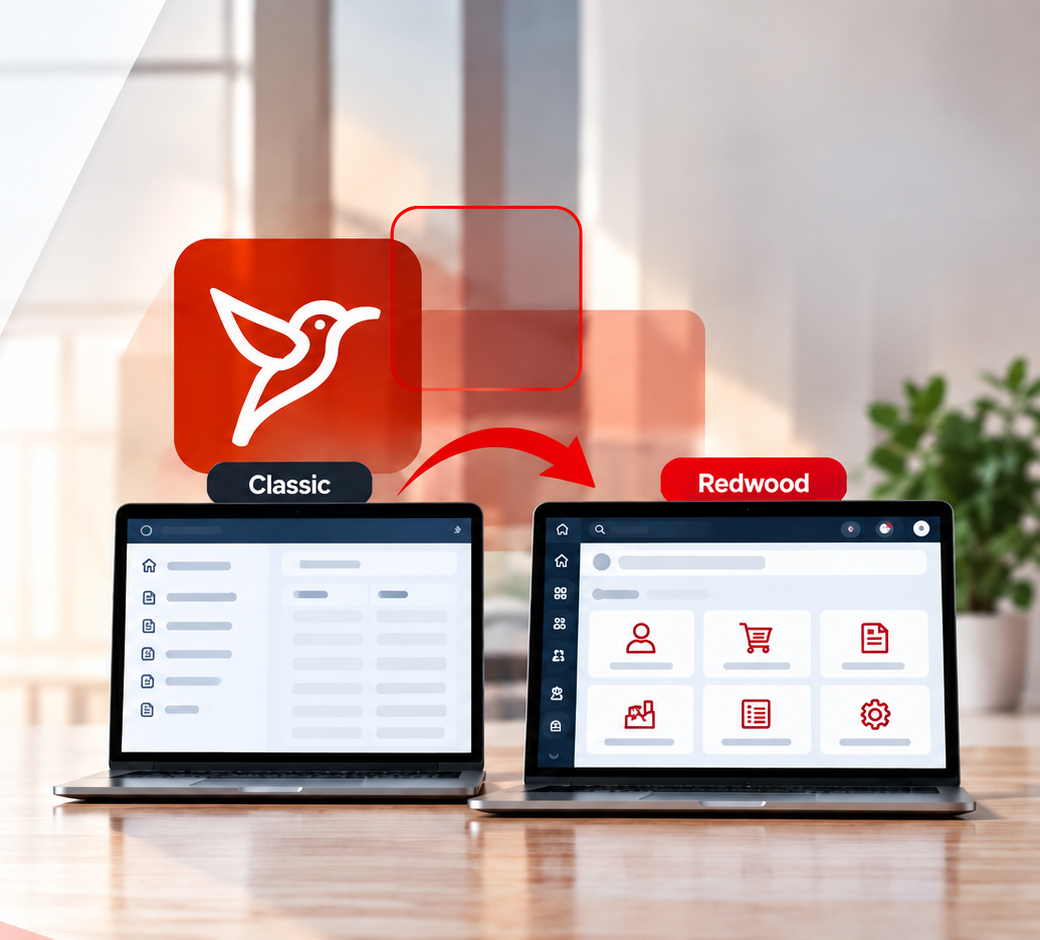
ACSE Solutions specializes in converting Oracle Fusion Cloud Classic pages to Redwood across Supply Chain, Product Information Management, Product Lifecycle Management, Finance, and Maintenance. We assess and convert the existing scripts, personalizations, and configurations behind your Classic experience.
A Proven Redwood Track Record
ACSE Solutions is actively supporting multiple enterprise Oracle Fusion Cloud clients through their Redwood transition today. Some of these engagements are in-flight — working through a phased, quarterly-update roadmap across Supply Chain and adjacent modules. Others have already reached Redwood go-live for the specific pages and transactions Oracle designated mandatory, completed on schedule ahead of Oracle's enforced deadlines and with zero disruption to production operations.
Across these engagements, ACSE has taken clients through the full Redwood lifecycle — impact assessment, personalization and configuration remediation, security-role revalidation, regression testing, and go-live cutover — for functional areas including Order Management, Procurement, Inventory, Manufacturing, Product Data Hub/PIM and Supply & Demand Planning.
Enterprise Modules We Support
Our Redwood conversion experience spans the following Oracle Fusion Cloud modules.
Supply Chain Management (SCM)
Order Management, Inventory Management, Manufacturing, Procurement, and Service Contracts.
Supply Chain Planning
Supply & Demand Planning, Demand Management, Supply Planning, forecasting, planning parameters, and plan-to-execution workflows.
Product Lifecycle Management (PLM)
Engineering, Product Development, Change Management, and related lifecycle processes.
Finance
General Ledger, Accounts Payable, Accounts Receivable, and related financial areas.
Maintenance Management
Work Management, Asset Management, and Maintenance Planning.
What a Redwood Conversion Involves
A Classic-to-Redwood conversion is rarely just a visual refresh. Three layers typically need attention, and we treat all three as first-class scope.
Custom Scripts
Every script tied to a Classic page — Page Composer logic, custom validations, and workflow-triggered scripts — reviewed and refactored so it runs natively on Redwood rather than relying on compatibility shims.
Personalizations
Full, page-by-page migration of user- and role-based personalizations, so layouts, field-level changes, and access rules different user groups depend on carry forward accurately — not just the ones that are easiest to find.
Configurations
A controlled, validated transition of the configuration decisions behind Classic pages into Redwood's architecture, so behavior stays consistent rather than being silently reset to Oracle defaults.
We know personalization-heavy environments — where pages have been customized extensively over multiple releases for different roles and business units — tend to be where generic Redwood upgrades run into trouble. That's the specific case our conversion methodology is built to handle: we inventory every personalization layer before touching anything, so nothing gets silently dropped in the move.
Mandatory Redwood Readiness (27A and Beyond)
Oracle continues to convert additional Classic pages and transactions to Redwood-only with each quarterly release, and a growing set of these conversions are mandatory rather than optional.
Mandatory-Scope Identification
Identifying which pages and transactions become mandatory Redwood-only in the upcoming release, using Oracle's Redwood Readiness report and "Determine Readiness for This Update" checklist.
Environment Validation
Validating the current environment — configurations, security roles, integrations, and reports — against each newly mandatory page.
Business-Process Impact Mapping
Tracing which specific business processes and user roles are affected, so remediation is targeted rather than blanket.
Oracle-Documentation-Driven Approach
Using current Oracle documentation and readiness reports, rather than static internal checklists, so recommendations reflect what Oracle is actually shipping that quarter.
Our Approach
A structured conversion approach helps enterprises manage business impact while moving from Classic to Redwood.
Readiness Assessment
Inventory every in-scope Classic page, script, personalization, and configuration; run Oracle's Redwood Readiness tooling to confirm what's mandatory versus optional for the current release.
Impact-Based Prioritization
Prioritize by business impact — the pages and processes teams touch every day move first; lower-usage items are sequenced to avoid unnecessary rework.
Conversion & Remediation
Refactor scripts, rebuild personalizations natively in Redwood using Visual Builder Studio rather than legacy Page Composer workarounds, and migrate configurations in a non-production environment.
Validation & Testing
Regression-test converted pages against priority business processes and security roles before anything reaches production.
Cutover & Knowledge Transfer
Transfer practical knowledge to the client's team and, where needed, provide a structured cutover and post-go-live support window.
Lessons From the Field
Every Redwood engagement teaches us something that improves the next one. A few patterns are worth planning for in advance.
Redwood Enablement Is Often One-Way
For certain pages and transaction flows, once the Redwood version is enabled there is no supported path back to Classic. Go/no-go decisions for each page need to be made with that finality in mind and communicated clearly to end users ahead of time.
Search Behavior Can Differ From Classic
Redwood search is not always a like-for-like replacement for Classic search. Some pages require more specific filters or criteria to return expected results. Left unaddressed, this can look like a data problem when it is really a difference in how search is designed to work.
Some Pages Need Data and Index Prerequisites
Certain Redwood pages depend on data ingestion and index rebuilding via ESS jobs before new or updated records display correctly. These prerequisites belong in the implementation and testing plan, not as post-go-live cleanup.
Classic Tasks Can Be Consolidated or Relocated
The Redwood experience does not always preserve Classic's exact task structure. Some tasks are consolidated, some relocated, and some removed. Training needs to introduce the new process directly rather than simply mapping where the old page moved.
Classic and Redwood Can Quietly Coexist
A page can go live in Redwood while its Classic equivalent stays fully functional alongside it. Without deliberate access control, different users can end up doing the same job two different ways.
Visibility Defaults to Existing Access
When a new Redwood page goes live, users who already held the equivalent Classic privilege typically inherit Redwood access automatically. Controlling who sees the new page is therefore a deliberate security-configuration step.
Why ACSE Solutions
ACSE is an Oracle Certified Cloud Partner with a dedicated Oracle Fusion Cloud practice, validated directly by Oracle across the solution areas most relevant to a Redwood conversion engagement.
This Oracle-validated expertise covers Order Management, Procurement, Product Lifecycle Management, and Supply Chain Planning, alongside Financials, Manufacturing, OCI Integration, EBS-to-Cloud, Cloud Native Applications, and AI the same functional breadth this conversion work draws on.
From Classic pages to a Redwood-ready enterprise experience.
We convert existing Oracle Fusion Classic pages, related scripts, personalizations, and configurations to Oracle Redwood — with a structured focus on business continuity, validation, and controlled transition.
Let's Talk About Your Redwood Roadmap
If your team is weighing how and when to move to Redwood, we'd welcome a conversation. We can walk through a readiness assessment and a practical roadmap tailored to your environment.
Contact ACSE to schedule a Redwood conversion assessment and roadmap discussion.
Contact ACSE Solutions →